What REAL Community Is
People don’t usually join cults because they’re gullible. They join because they’re looking for community — belonging, purpose, the feeling of being fully seen. That hunger is real, and it’s exactly what the recruitment pitch is built to answer. The tragedy is what actually gets delivered once you’re in.
I spent about twenty years inside that bait-and-switch. It’s taken years of studying cults and writing my own book to get language for what was actually missing the whole time: what “community” is supposed to feel like when it’s the real thing.
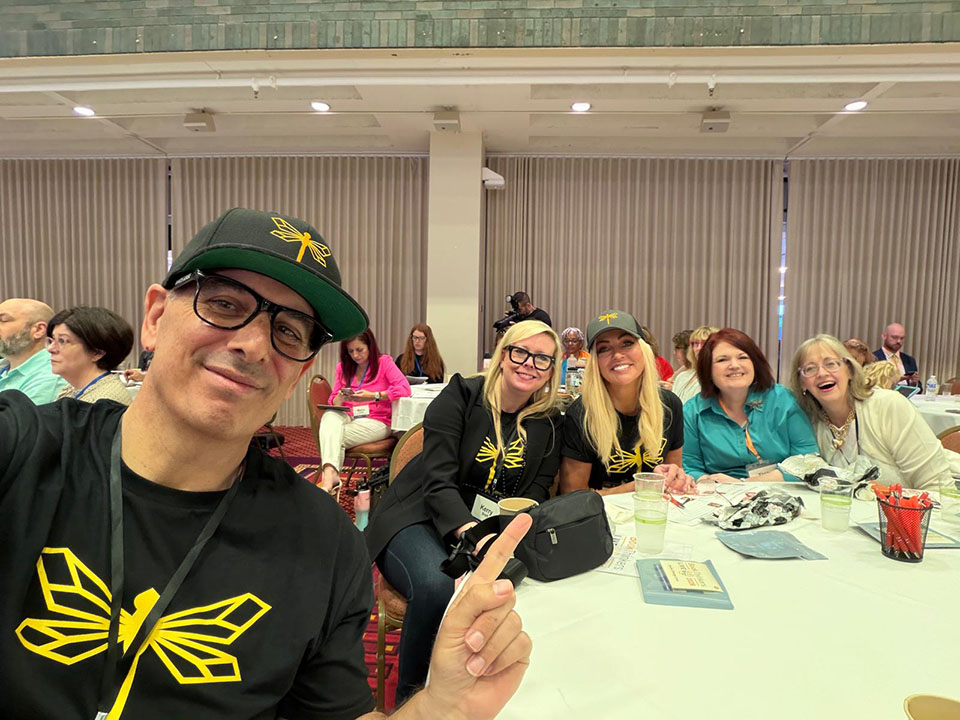
This past weekend, at two phenomenal conferences — BookThinkers Live and Cre8tive Con — I got a clean, close-up look at it. Neither conference was my first since I left Scientology. What was new was finally having the words for why they felt so different.
Here are five things I could finally see.
1. Real community gives you something
In Scientology, a huge percentage of the talking that happens in a room is not information. It’s not even facts. It’s performance. A person demonstrating status, reinforcing doctrine, or running out the clock until the sales pitch. The content is almost beside the point; the point is that you sat there and absorbed it. That’s not community. That’s an audience.
At BookThinkers and Cre8tive Con, speakers operated on a different assumption: that my time was worth something, and their job was to hand me something I could use before I walked out the door. A tool. A framework. A specific tactic I could apply that afternoon. Real community treats your time as valuable. It doesn’t just fill it.
2. Real community doesn’t have a toll booth
Every high-control group has some version of the locked room. In Scientology it’s structural: sec checks (metered interrogations), courses gated behind purchases, auditing (counseling) you can’t access without paying for the next intensive. Belonging comes with a running tab, and you don’t leave a session without being asked, pushed, or maneuvered into paying it down.
At both conferences this weekend, the model was almost aggressively the opposite. Speakers offered ways to go deeper — consulting, a course, a book — then said some version of “no pressure, that’s just where to find me” and moved on.
Nobody stood between me and the exit. Real community doesn’t charge admission to keep talking to you.
3. Real community invites difference
Robert Jay Lifton wrote about “loading the language” — the way a closed group narrows the words you’re allowed to use until it narrows the thoughts you’re able to have. In Scientology, sameness isn’t an accident; it’s maintained. Vocabulary, opinions, even demeanor get sanded down over time until everyone in a room reads as a single organism wearing different faces. It’s absolutely chilling when you get out of it and look back.
A group that requires sameness to hold together isn’t a community. It’s a formation.
This weekend, I sat with people who disagreed about craft, about business models, about almost everything — and the room held it fine. Nobody needed to be handled. Real community doesn’t need you to agree with it to keep you in it.
4. Real community doesn’t assess your worth
In Scientology, most interactions with a stranger carry an invisible question underneath them: Are you worth the investment? They want to know if this person in front of them is promising, reachable, sellable. Conversations aren’t really conversations — they’re the opening move of an assessment. Being talked to and being sized up start to feel like the same thing.
This weekend, people talked to me because talking to me was the whole activity. Nobody was quietly running the numbers on whether I’d convert into a customer or a follower or a recruit. Real community doesn’t need you to be useful to be worth talking to.
5. Real community isn’t conditional
What I didn’t understand until much later is that everything above is what real community actually feels like. Not everyone agreed. They didn’t all come from the same place. They didn’t owe anyone anything for being there. None of that was ever a condition. People showed up because they wanted to, stayed as long as they wanted to, and left without a debt attached. Nobody’s belonging was ever on the table as leverage.
That’s the part that took the longest to unlearn. When I first left Scientology and started to dip my toe into various communities, I would freak out whenever someone mentioned going further or becoming more a part of their group. And I’d leave — which was amazing, because I could leave. With no penalty.
In Scientology, community and control are fused. The moment you question the group, the “community” disappears, because it was never separate from your compliance to begin with. Real community doesn’t work that way. It doesn’t collapse the second you disagree, and it isn’t the reward for good behavior. It’s just there, whether or not you’re useful to it that day.
This is the biggest lie in the recruitment pitch: the promise of belonging, with the small print that belonging was conditional all along. And it’s why the first four things above matter as much as they do — not because they’re etiquette, but because each one is a different way of proving the belonging is real.
The truth about community
None of these five things are random, and none of them are really about conferences. They’re about what it takes for a group to actually be a community instead of a control structure: it has to be able to survive disagreement, survive people walking out the door, survive you leaving without buying anything, survive not needing anyone to join, and survive not being the only source of your belonging.
This weekend didn’t teach me anything new about community — it just gave me another clear example of it. And these two communities are filled with some of the most intelligent, kind, truly helpful people I’ve ever met.
If you’ve spent time in a high-control group, some of this is probably uncomfortably familiar. If you haven’t, consider this a small field guide to what real community feels like when nobody’s controlling the exits.
And if your Spidey senses start tingling when you read this, maybe it’s time to rethink what your community is providing.
Incredible truth. OBSESSED!
Thanks friend! You’re an inspiration!
Thanks so much for sharing your experience and the kind words. Your spirit lifted our room and took the weekend to a whole different level.
Thanks for being you!
Thanks Dom! XO